Not Every Discovery Happens in a Laboratory
Not every discovery happens in a laboratory
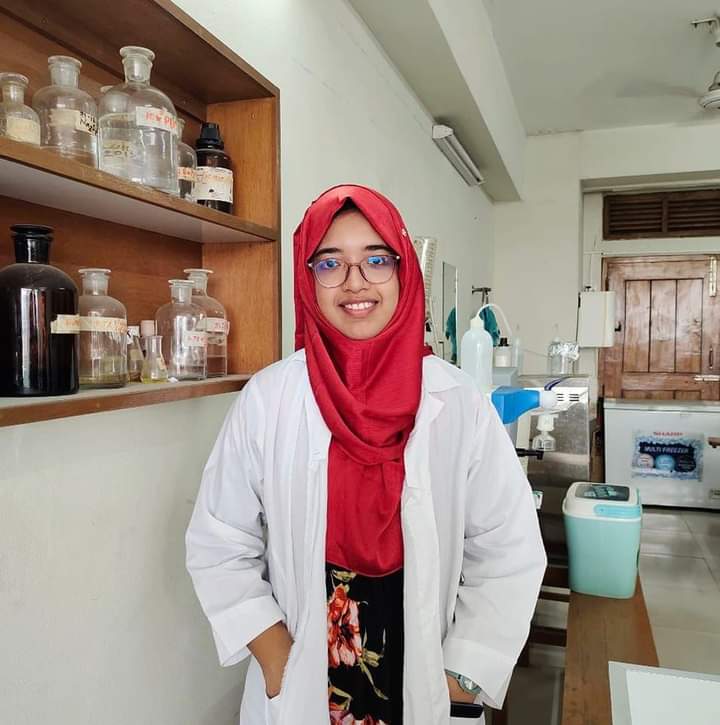
I'm Rahnuma Tabassum, a student of the Department of Biochemistry and Molecular Biology at Jagannath University. When I applied for the GSA Bioinformatics Internship, I wasn't trying to switch fields. I wasn't looking to become a programmer either. I simply wanted to understand a side of biology that had always fascinated me but also intimidated me.
As biochemistry students, we're taught how to think about cells, proteins, genes, and diseases. We spend countless hours learning laboratory techniques and understanding biological mechanisms. But somewhere along the way, I realized that another world existed—one where thousands of biological questions could be explored through data.
That curiosity was enough to make me apply. At that point, I had no idea that a few months later I would be writing R scripts, analyzing transcriptomic datasets, discussing research papers almost every day, and genuinely enjoying the process.
Learning something completely new isn't comfortable—and that's okay
The first few weeks were challenging. Unlike many people assume, bioinformatics isn't just clicking buttons on software. It requires patience, logic, and a willingness to spend hours figuring out why a single line of code isn't working. I remember staring at error messages that looked like a completely different language. Sometimes fixing one mistake created two new ones. There were days when I questioned whether computational biology was really for me.
But something interesting happened. Instead of getting discouraged, I became curious. Every error taught me something. Every solved problem made the next challenge feel a little less impossible. Slowly, R stopped looking like random commands and started becoming a tool that helped answer biological questions. Looking back, I think those frustrating moments were actually the ones where I learned the most.
Finding biology inside thousands of genes
My internship project focused on Hepatocellular Carcinoma (HCC), one of the most common and deadly forms of liver cancer. Before this internship, I had always associated research with pipettes, culture plates, and laboratory benches. Working with transcriptomic data completely changed that perspective.
I learned how researchers combine datasets from different studies, identify differentially expressed genes, explore biological pathways, construct protein interaction networks, and eventually narrow down potential biomarkers that could be important for diagnosis or treatment. The exciting part wasn't simply obtaining results. It was realizing that every graph, every heatmap, and every significant gene represented a biological story waiting to be understood. That was the moment I truly appreciated the power of bioinformatics.
A mentor makes all the difference
Every internship teaches skills. Not every internship gives you a mentor who changes the way you think.
One of the biggest reasons this experience became so meaningful for me was the guidance of Md. Jubayer Hossain Bhai. He never encouraged us to memorize workflows. Instead, he constantly asked us to understand why we were performing each analysis. If something didn't make sense, asking questions was never discouraged. In fact, questions were expected. I don't think I can count how many times I interrupted with "Why does this happen?" or "Can we do it another way?"
Looking back, those discussions probably taught me more than the coding itself. More importantly, he reminded us that research isn't about producing beautiful figures. It's about producing results that are honest, reproducible, and scientifically meaningful. That lesson will stay with me far beyond this internship.
More than an internship
When people hear "internship," they usually imagine learning technical skills. The GSA internship certainly gave me those. But what surprised me most was everything beyond the technical part. It taught me how to read scientific literature without feeling overwhelmed, how to question published findings instead of accepting them blindly, and how much we can learn simply by discussing ideas with people from different universities and academic backgrounds.
Some of the best learning moments happened outside the official sessions—during conversations, brainstorming, and sharing frustrations over stubborn pieces of code that refused to cooperate. Those moments reminded me that science is rarely a solo journey.
How it changed my future
If someone asks me what I gained from the GSA Bioinformatics Internship, I probably won't start by mentioning R programming or transcriptomics. I'll say it gave me confidence. Confidence to explore fields I once considered too difficult. Confidence to work on interdisciplinary research. Confidence to believe that I don't have to choose between wet lab and dry lab—they can complement each other beautifully.
Today, I see bioinformatics not as an alternative to experimental biology, but as a powerful extension of it. And that realization has shaped how I want to approach research in the future.
To the next cohort
If you're joining the next GSA Bioinformatics Internship, don't worry about whether you already know enough. Most of us didn't.
- Come with curiosity.
- Be willing to ask questions.
- Don't be afraid of making mistakes—they're part of learning.
- And whenever things become difficult, remember that every researcher you admire once stared at confusing datasets and mysterious error messages too.
The difference is that they kept going. I'm grateful that I did too.